
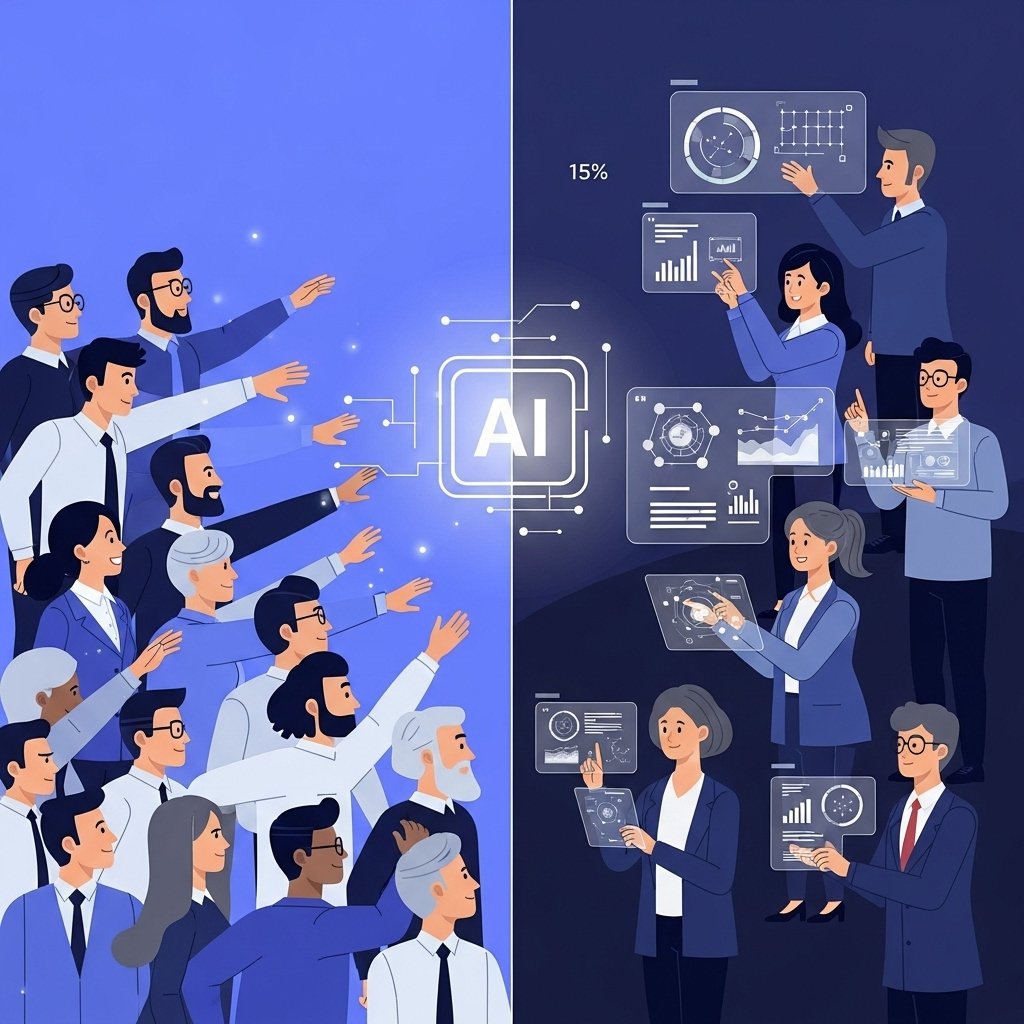
There's a revealing statistic that captures where we are with AI adoption: 85% of small and mid-sized businesses say they want to use AI. They recognize its potential and understand it could transform their operations. But here's the reality: less than 15% have actually implemented AI in any meaningful way.
That's not a small gap—that's a chasm. And it represents one of the most significant business opportunities of our time.
This isn't about businesses being resistant to change. Most leaders understand AI's importance. They've read the articles, seen the success stories, and know their competitors are likely exploring it. The desire is real, the intention is genuine. But something is blocking the path from wanting AI to actually using it.
At anelion, we see this gap every day. We work with businesses on one side trying to cross over. What we've learned is that the gap isn't really about technology—it's about transformation. The distance between AI talk and AI action is filled with very real, very human challenges.
Understanding why this gap exists—and more importantly, how to bridge it—is essential for any business that wants to stay competitive.
Why The Gap Exists
Several obstacles combine to create this divide, and individually they seem manageable, but together they become overwhelming.
The first is confusion about what "using AI" actually means in practical terms. Business leaders have heard about ChatGPT and machine learning, but translating that into specific applications for their business is unclear. Should they build custom models? Use off-the-shelf tools? The technology landscape moves so fast that many don't know where to start.
This confusion breeds paralysis. When you don't understand what you're supposed to do, doing nothing feels safer. The problem is, waiting for clarity means waiting while competitors pull ahead.
Then there's the resource challenge. Small and mid-sized businesses already operate with tight budgets and limited staff. Adding AI implementation on top of daily operations feels impossible. Even when they want to prioritize it, they don't see how to fit it into existing constraints.
This creates a catch-22: AI could make them more efficient and free up resources, but they feel they need more resources to implement AI in the first place.
There's also legitimate concern. What if we invest in the wrong tools? What if we spend money and see no return? What if AI disrupts operations more than it helps? These aren't irrational fears—they're real risks that need to be weighed.
But here's what happens: this caution often leads to endless research and waiting for the "perfect" moment or the "right" solution. Meanwhile, the 15% who have implemented AI are getting faster, smarter, and more competitive.
The Real Cost of Staying in the 85%
Here's what's often missed: the cost of not implementing AI isn't neutral. You're not just maintaining your current position—you're actively falling behind.
Every day without AI is a day your AI-equipped competitors are getting more efficient, serving customers better, and building advantages that compound over time. They're not just doing what you do with AI added on—they're operating fundamentally differently.
Your competitor with AI can analyze customer patterns you'll never spot manually. They can personalize at a scale you can't match. They can respond to market changes before you even notice them. The gap in capabilities grows every day.
This has real financial impact. AI-equipped businesses are reducing costs through automation while increasing revenue through better customer experiences and faster responses. That combination—lower costs and higher revenue—creates a competitive advantage that compounds.
There's also a talent dimension. Top employees increasingly prefer businesses that embrace modern tools and processes. If you're stuck in manual workflows while competitors offer AI-enhanced work environments, you're at a disadvantage in attracting and retaining talent.
And the longer you wait, the harder it gets. Businesses implementing AI now are learning, improving, and building on their investments. When you finally start, you're competing not just with their current state but with where they'll be by the time you catch up.
The gap isn't static—it's growing.
How We Bridge The Gap
At anelion, bridging this gap is our focus. We've helped businesses move from the 85% to the 15%, and the path forward starts with clarity.
Before discussing tools or implementation, we help businesses understand what AI can actually do for them specifically. Not AI in theory, but AI applied to their unique operations and opportunities. We take time to understand their business, then show them—concretely and specifically—where AI creates value.
This clarity is transformative. Once you can envision how AI works in your context, the confusion clears. You move from "AI is important but I don't know how" to "I can see exactly how AI would improve these aspects of my business."
Next comes strategy. Not a generic AI strategy, but a tailored roadmap acknowledging your specific constraints, resources, and goals. We identify the highest-impact opportunities—where AI creates the most value with the least disruption. We prioritize based on what works for your business.
This is crucial because trying to do too much too fast leads to failure. We help businesses start where it matters most, build confidence, then expand. Small wins create momentum. Momentum creates more wins.
Implementation is where we really make a difference. We don't just recommend tools and leave. We help businesses actually integrate AI into operations—working alongside teams, training people, adjusting as we learn, and ensuring AI becomes embedded in how they work.
We handle the technical complexity so leaders can focus on running their businesses. We translate between AI capabilities and business needs, making sure solutions actually solve real problems.
Throughout, we're building capability within the organization. The goal isn't dependence—it's self-sufficiency. We want teams to understand AI well enough to identify new opportunities and continue evolving their use long after we're gone.
The Opportunity Hidden in the Gap
Here's what most people miss: this adoption gap isn't just a challenge—it's an extraordinary opportunity.
Right now, 85% of your competitors want AI but don't have it. They're struggling with the same confusion and constraints. They're stuck in the same paralysis.
But most of them will stay there. They'll still be in the 85% next year and the year after. They'll keep wanting AI, keep talking about it, but never bridge the gap.
If you can cross that gap—if you can move to the 15%—you're not just keeping up. You're pulling ahead of the vast majority of your competitive set. You're operating with capabilities most of your market doesn't have.
The businesses that move first don't just gain an advantage—they often gain a decisive one. They learn faster, optimize better, and build more sophisticated systems while everyone else is still figuring out where to start.
This is the opportunity cost of waiting. Every month in the 85% is a month you could be building competitive advantage and positioning for a future where AI isn't optional.
And here's the key: bridging this gap is more accessible than most businesses realize. You don't need a massive budget. You don't need to become a technology company. You need the right guidance to navigate from curiosity to transformation.
Moving Forward
The gap between wanting AI and using AI is real and growing. But it's not insurmountable. Every business we work with at anelion started on the wrong side. They were in the 85%—wanting AI, seeing its potential, but not knowing how to make it real.
Now they're in the 15%. They're operating with AI integrated into their processes. They're more efficient, more competitive, and better positioned for the future.
The path from where you are to where you need to be is clearer than you think. It starts with understanding your specific opportunities. It continues with a realistic strategy tailored to your resources. It succeeds through guided implementation that handles complexity while building capability.
You don't have to figure this out alone. That's what we do—we've walked businesses across this gap, and we can walk yours across too.
The businesses that thrive won't be the ones that wanted AI—they'll be the ones that implemented it. The question is whether your business will be one of them.
To learn more about how anelion can help your business bridge the AI adoption gap, contact us at [email protected].