
Most business software today exists primarily as an interface between humans and data. We click buttons, fill forms, navigate menus, and read dashboards. This interaction layer—the UI/UX—represents a substantial portion of any software application's complexity and cost. But a fundamental question is emerging: how much of this layer is actually necessary?
The traditional software paradigm assumes humans must be directly involved in data entry, analysis, and decision-making at every step. AI changes this assumption. It creates the possibility of software that handles these processes autonomously, with humans stepping in only for review and approval of outcomes.
This isn't about adding chatbots or AI assistants to existing interfaces. It's about reconsidering whether the interface itself needs to exist in its current form.
The UI/UX Problem in Traditional Software
Consider how much of your daily software interaction involves routine data entry. Updating records. Filling out forms. Copying information from one system to another. Generating reports. Reviewing dashboards to spot patterns or anomalies.
These activities consume significant time, yet they're often mechanical. You're not making complex decisions—you're moving data around and looking for things that need attention.
Traditional software requires this human involvement because it can't understand context or make judgments. It needs you to tell it exactly what to do, step by step. The interface exists to translate your intentions into actions the system can execute.
But building these interfaces is expensive. A substantial portion of software development cost goes into designing screens, handling user input, validating data, managing errors, and creating the visual layer that humans interact with. Maintenance of this layer adds ongoing cost as requirements change and user expectations evolve.
The irony is that much of this elaborate interface exists simply to collect information and present it back to you in forms that help you make decisions the software can't make on its own.
What AI Changes
AI systems can understand unstructured information. They can process natural language, interpret documents, and extract meaning from data without requiring carefully designed input forms. They can analyze patterns across large datasets and identify anomalies without requiring someone to build specific reports.
This capability opens a different approach to software design. Instead of building interfaces for humans to enter and analyze data, you can build systems where AI handles these functions directly.
Consider a simple example: expense reporting. Traditional expense software requires employees to photograph receipts, manually enter amounts and categories, select appropriate cost centers, and submit for approval. Managers then review each expense, checking for policy compliance and reasonableness.
An AI-native approach works differently. The AI processes receipts directly—reading amounts, identifying merchants, categorizing expenses based on historical patterns and company policy. It flags anything unusual or policy-adjacent for human review. Routine expenses that clearly comply with policy are processed automatically. Humans only engage when their judgment is actually needed.
The interface in this model is minimal. Rather than screens for data entry and navigation, you have a simple queue of items requiring human attention, with the AI's analysis and recommendation already attached.
From Data Entry to Decision Review
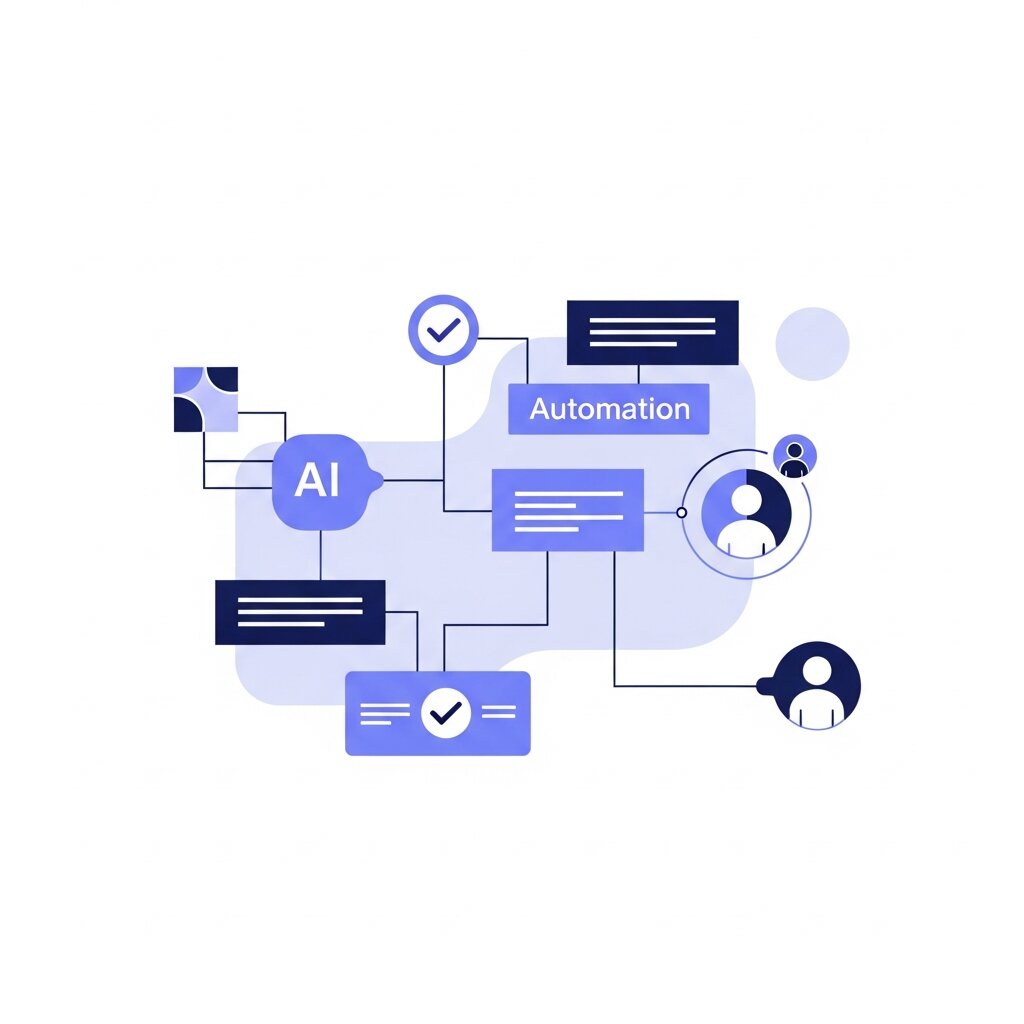
The shift here is from human-as-operator to human-as-reviewer. Traditional software positions people as the primary actors—entering data, running analyses, making decisions at each step. AI-native software positions people as supervisors—reviewing AI work, approving recommendations, handling exceptions.
This changes what the interface needs to do. Instead of comprehensive screens for every possible action, you need:
Clear presentation of AI recommendations and the reasoning behind them. Efficient mechanisms for approval, rejection, or modification. Escalation paths for situations requiring deeper human judgment. Audit trails showing what was decided and why.
The interface becomes simpler because it's focused on review rather than operation. There are fewer screens, fewer input fields, fewer navigation paths. The complexity shifts from the interface layer to the AI layer underneath.
Practical Applications
This pattern applies across many business processes that currently require extensive human interaction with software.
Invoice processing traditionally requires someone to receive invoices, enter key data, match against purchase orders, route for approval, and schedule payment. AI can read invoices directly, extract relevant data, perform matching automatically, and present only exceptions for human review. The bulk of invoices—those that match expectations—flow through without human touch.
Customer service interactions typically require agents to navigate complex systems, look up customer history, follow decision trees, and document outcomes. AI can understand customer requests, access relevant information, apply policies, and resolve straightforward issues autonomously. Agents handle only situations requiring human judgment or empathy.
Inventory management usually involves reviewing reports, spotting trends, making reorder decisions, and entering purchase orders. AI can monitor inventory levels, predict demand based on patterns, generate recommended orders, and present these for approval. The human role shifts from analysis to validation.
In each case, the traditional interface—with its forms, screens, and navigation—becomes largely unnecessary. What remains is a streamlined review layer.
The Cost Implications
Reducing the UI/UX layer has significant cost implications. Interface development and maintenance represent a major portion of software budgets. User training costs decrease when there's less to learn. Support costs decline when there are fewer screens where users can encounter problems.
But the larger cost benefit comes from reduced labor in operating the software. When AI handles routine data entry and analysis, people spend less time on mechanical tasks. The hours previously devoted to entering data and reviewing dashboards become available for work that actually requires human judgment.
This isn't primarily about reducing headcount. It's about redirecting human effort from tasks machines can handle to work that benefits from human capabilities. The expense report clerk becomes the exception handler. The customer service agent becomes the resolution specialist for complex cases. The inventory manager becomes the strategic buyer.
The value of human time increases because it's applied to higher-value work.
Limitations and Considerations
This approach isn't appropriate for every situation. Some processes genuinely require human judgment at each step. Some decisions involve nuance that AI can't reliably assess. Some domains lack the data needed for AI to operate effectively.
There's also the question of trust. Organizations need confidence that AI decisions meet their standards before reducing human oversight. This typically requires a period where AI recommendations are reviewed comprehensively before moving to exception-based review.
And the transition itself requires care. People who currently operate traditional interfaces need to understand their new role in an AI-native system. The skills required to review AI work differ from the skills required to operate software directly.
How anelion Helps
At anelion, we help businesses identify opportunities to move beyond traditional software interfaces. We analyze existing processes to find where AI can take over routine data handling and decision-making, freeing your team to focus on review and judgment.
We design AI-native systems that minimize the interface layer while maximizing human oversight of outcomes. This means building software that presents AI recommendations clearly, supports efficient approval workflows, and handles exceptions appropriately.
Our approach emphasizes practical implementation. We start with processes where AI capabilities are well-matched to the task, building confidence before expanding scope. We ensure humans remain in control of decisions that matter while eliminating their involvement in decisions that don't require their judgment.
The result is software that costs less to build and operate, while making better use of your team's time and expertise.
Conclusion
The traditional software interface exists because machines needed humans to translate intentions into actions. AI changes this equation. It creates the possibility of software where machines handle data collection, analysis, and routine decisions while humans focus on review, approval, and exception handling.
This isn't a distant future—it's possible today for many business processes. The question is whether your organization will continue investing in traditional interfaces that require constant human operation, or move toward AI-native systems that require only human oversight.
To learn more about how anelion can help your business reduce interface complexity while improving decision quality, contact us at [email protected].