
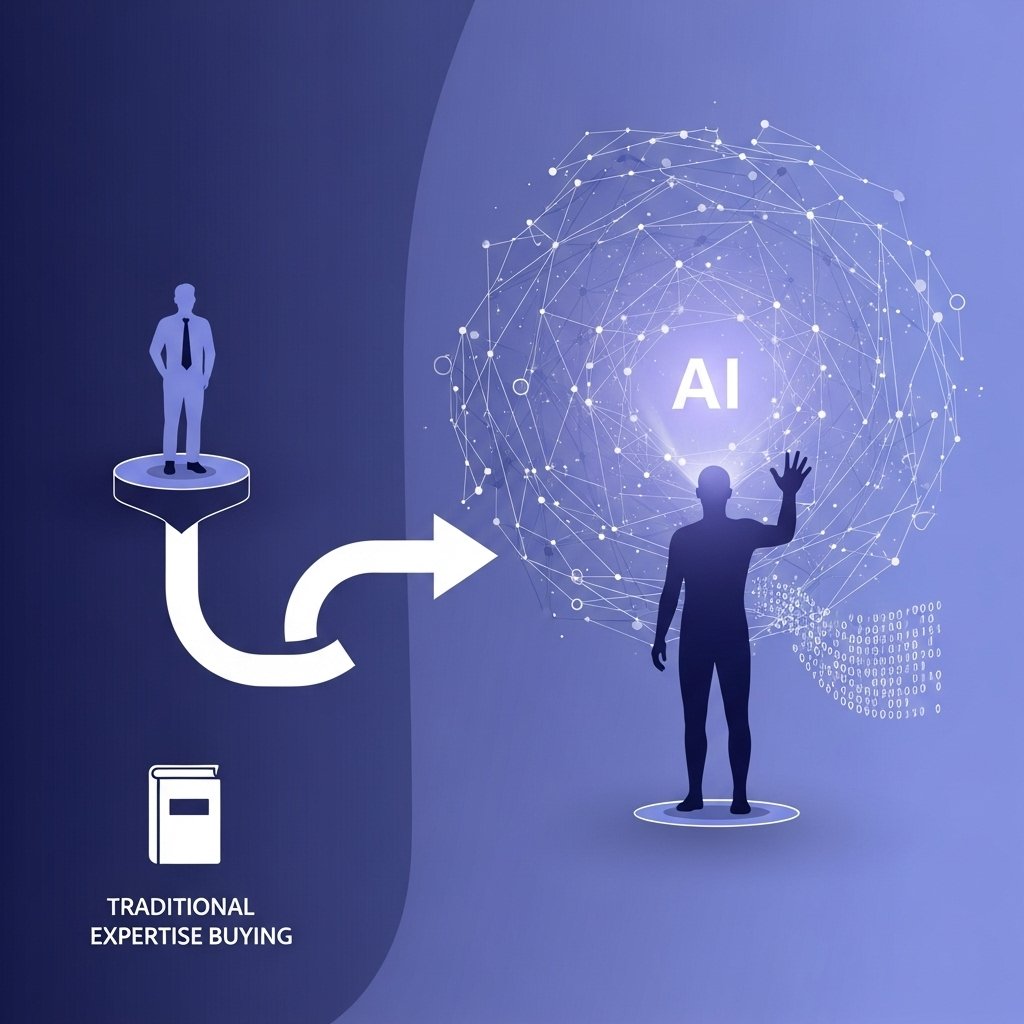
For your entire career, you've operated under a basic assumption: when you need expertise you don't have, you buy it. You hire a consultant, engage a specialist, bring on a new team member, or pay for training.
This has been the fundamental trade-off of business. Want legal expertise? Hire a lawyer. Need marketing know-how? Bring in an agency. Require technical skills? Find a specialist.
AI is breaking this assumption in a profound way. And the businesses that recognize this shift first are gaining extraordinary advantages.
The Old Model
The traditional approach to expertise has clear limitations. Specialized knowledge is expensive—consultants charge hundreds per hour, agencies require retainers, and full-time experts command premium salaries. This creates a practical ceiling on how much expertise you can access.
You also face availability constraints. The expert you need might be booked for months. The agency can only handle so many clients. The consultant has limited hours. When you need expertise, you often can't get it exactly when you need it.
There's also a scope limitation. You pay for expertise in discrete chunks—a project, a retainer, a role. If you need five minutes of insight from a domain expert, you still pay for their minimum engagement. This makes it impractical to access expertise for small decisions or quick questions.
The result? Most businesses operate with significant knowledge gaps. They make decisions without full expertise because accessing that expertise isn't economically viable for every decision.
The AI Shift
AI trained on specialized domains fundamentally changes this equation. That legal question that would cost $500 for a lawyer's time? AI can provide initial analysis immediately. The marketing expertise that requires an agency retainer? AI can offer strategic input on demand. The technical knowledge that needs a specialist? AI can provide guidance instantly.
This isn't about replacing all human expertise—it's about dramatically lowering the barrier to accessing knowledge. Questions that were too small to justify expert consultation become answerable. Decisions that you'd make without specialized input can now be informed by relevant expertise.
Think about what this means in practice. You're considering a new market—AI can synthesize regulatory requirements, competitive landscape, and market dynamics instantly. You're evaluating a vendor—AI can analyze contracts, identify standard terms versus unusual clauses, and highlight risks. You're optimizing a process—AI can draw on best practices from thousands of documented cases.
The expertise gap that constrained your decisions is narrowing dramatically.
The Mindset Shift Required
But here's what we see at anelion: most businesses haven't made the mental shift to leverage this. They're still operating in the old model—still thinking they need to "buy" expertise every time they need it.
The businesses pulling ahead have fundamentally reconceptualized their relationship with expertise. They've shifted from "expertise as something we acquire" to "expertise as something we access."
This seems subtle, but it's profound. When expertise is something you acquire, you're conservative about when you access it because there's always a cost consideration. When expertise is something you access on-demand through AI, you can bring expert-level analysis to decisions that would never have justified expert consultation before.
A practical example: You're reviewing a new supplier contract. Old mindset: "This is a standard supplier agreement, we probably don't need legal review." New mindset: "Let me get expert analysis on this immediately." The AI can flag unusual clauses, identify potential risks, and suggest modifications—all in minutes, at minimal cost.
The barrier to accessing expertise has dropped from "Is this worth $500?" to "Is this worth five minutes?" That's a fundamentally different threshold, and it changes which decisions get expert input.
What This Unlocks
When you internalize this shift, several things happen to your business:
First, decision quality improves across the board. Decisions that would have been made with limited information now benefit from relevant expertise. You're not just getting expert input on major decisions—you're getting it on hundreds of small decisions that collectively matter enormously.
Second, you move faster. Instead of waiting days or weeks for expert consultation, you get immediate input. The lag between question and expert-informed answer shrinks from days to minutes. This accelerates everything from strategy development to execution refinement.
Third, you become more ambitious in what you pursue. When accessing expertise for new ventures was prohibitively expensive, you'd stick to what you knew. When you can immediately access expertise in new domains, you can explore opportunities that would have seemed out of reach.
A small business can evaluate international expansion with the same depth of analysis as a multinational. A startup can approach sophisticated financial modeling with expert-level capability. A mid-sized company can explore technical innovations without hiring specialists first.
The Practical Application
Here's how this plays out in practice:
Strategic Planning: Instead of paying consultants tens of thousands for market analysis, you use AI to conduct deep competitive analysis, identify market trends, assess positioning options, and evaluate strategic scenarios. You still might engage consultants for final strategy development, but you're coming to that conversation far more informed.
Operational Decisions: Every process improvement, vendor evaluation, or efficiency question can now get expert-level analysis. You're not limited by budget—you can bring expertise to every optimization opportunity.
Learning and Development: Rather than sending teams to expensive training or hiring for specialized knowledge, you can access expertise on-demand as needed. This just-in-time learning is often more effective than front-loaded training anyway.
Risk Management: You can run expert-level risk analysis on decisions that wouldn't have justified risk consultation before. This means catching potential issues earlier and more consistently.
The Hybrid Approach
This doesn't mean human expertise becomes irrelevant—far from it. What changes is when and how you engage it.
You use AI for initial analysis, research, and exploration. You use AI to frame problems correctly and identify key considerations. You use AI to narrow options and surface insights.
Then you bring in human experts for the judgment calls, the nuanced decisions, the strategic choices that require experience and intuition. You're not paying experts to do research you can do with AI—you're paying them to apply judgment to well-researched problems.
This hybrid approach gets you better outcomes at lower cost. The expert's time is spent on what they do best—nuanced judgment and creative problem-solving—not on research and analysis that AI can handle.
Why This Matters Now
The businesses that make this shift now are building a significant advantage. They're making better decisions, moving faster, and exploring opportunities that competitors don't even consider.
Meanwhile, businesses still operating in the old mindset—still thinking they need to "buy" expertise whenever they need it—are making decisions with less information, moving slower, and constraining themselves to familiar domains.
The gap between these two groups grows daily. One group is operating with near-universal access to expertise. The other is rationing expertise because they haven't realized the access model has changed.
At anelion, we help businesses make this transition. We don't just implement AI tools—we help organizations reconceptualize their relationship with expertise. We show them how to access knowledge they previously couldn't justify acquiring, how to bring expert analysis to decisions at every level, and how to move from expertise scarcity to expertise abundance.
The assumption that you need to buy expertise when you need it has shaped business for generations. That assumption is breaking. The question is whether your business will be among the first to operate in the new reality or among the last to cling to the old one.
To learn more about how anelion can help your business access expertise in new ways, contact us at [email protected].